ARCHIVE SIGNAL General
Administration Without Autonomy
Soul/'s administration surfaces collect evidence, prepare exact device-scoped work, preserve recovery paths, and stop before unattended maintenance, remediation, or public consequences can begin.
An Assistant Is Not A Sysadmin With Better Branding
The obvious next step for a local assistant that can inspect systems, understand a network, track backups, and notice security alerts is to hand it the keys and ask it to “keep things healthy.”
That is also how a useful assistant becomes a very articulate source of unexplained changes.
Soul/’s administration surfaces exist because I want the useful part: current evidence, a coherent picture of the machine and its supporting systems, exact plans for routine work, and enough continuity that a maintenance window does not begin with archaeology.
I do not want an unattended operator deciding that a host should update, reboot, prune a backup, suppress an alert, or alter a remote service because the dashboard happened to be quiet for a few minutes.
So Soul/’s approach is administration without autonomy.
It can collect, preserve, compare, explain, preview, and verify. It can sometimes perform a narrow action after I authorize the exact scope. But it cannot turn visibility into authority, and it cannot turn an old approval into a standing permission slip.
The Administration Surface Is A Map, Not A Command Deck
The current Administration area groups several things that are easy to confuse when they appear in the same dashboard:
- Project Timeline is the owner-maintained ledger of implementation work, priorities, deferrals, and completed evidence.
- Local Topology presents read-only route and network relationships without inventing reachability or a richer device state than the evidence supports.
- Backup & Recovery records encrypted snapshots, deletion holds, retention evidence, off-device continuity, and isolated restore staging.
- Guided Maintenance owns the boundary between observing a system and performing one explicitly supported update, reboot, or restoration action.
- Review Center is an audit surface for redacted pending approvals and recent bounded execution evidence. It does not grant approval authority merely because it displays the word “review.”
There is a common pattern underneath each one:
inspect current evidence
→ preview one exact change
→ authorize the displayed scope
→ execute in the owning lane
→ verify and retain the receipt
The most important word in that sequence is exact.
“Run maintenance” is not a useful authority boundary. It could mean updates, cleanup, a kernel change, a service restart, a reboot, an AUR rebuild, or an attempt to tidy a backup repository until it no longer contains the recovery point I eventually need. Soul/ instead works from defined capability boundaries and current evidence.
If it cannot say what it would do, it is not allowed to do it.
Maintenance Begins With Observation
Guided Maintenance is the clearest expression of that idea.
At first glance, it resembles a small infrastructure control room. It shows the current fleet summary, package and kernel attention, reboot evidence, device cards, status-only appliances, and a read-only security posture. There is a Collect fleet status control.
What it does not have is a “fix everything” button.
The page itself states the contract plainly: select one node, review, authorize, verify. Every card owns its own maintenance and reboot scope. A status-only appliance may be visible and refreshable, but it is not thereby granted SSH authority, a package manager, or a restart control.
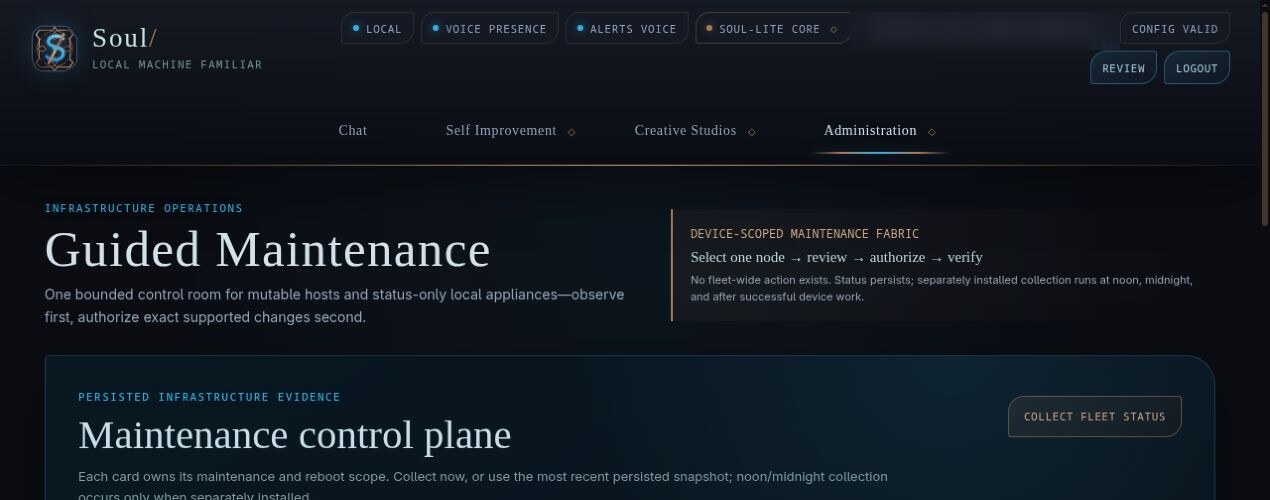
Guided Maintenance begins with a deliberately unglamorous statement of scope: one node, one reviewed action, one verification. Fleet status can be collected, but no fleet-wide action exists. Select any screenshot to open the full-resolution image.
This distinction matters because fleet information is not uniform.
Some systems have a reviewed, fixed adapter capable of reporting package, kernel, service, and lifecycle evidence. Some have a rich but strictly inventory-only adapter. Others are status-only: they can show bounded reachability and their most recent evidence, but Soul/ does not imply that online means manageable.
The dashboard keeps those categories visible instead of flattening every device into the same reassuring green card.
An inventory card is not a remote shell.
A Maintenance Request Has To Name Its Target
Soul/ can receive an explicit request through Chat or Voice Presence—for example, a request to run maintenance on one named trusted device.
That request does not immediately send a command.
Soul/ resolves one exact managed device from the current fleet snapshot, identifies the existing fixed adapter, repeats the device label and the no-reboot boundary, and prepares a preview. A short-lived confirmation is bound to the server-authored digest of that exact plan. It expires after ten minutes.
Completion returns progress, a device receipt, refreshed evidence, remaining update count, reboot state, and bounded failure information. There is no automatic retry and no background continuation once the foreground request returns.
Reboot is more protected still.
For a workstation or any action with larger consequences, conversation can explain and prepare the path, but a typed or spoken affirmation is not execution authority. The final action belongs to the Dashboard, a reviewed terminal command, or the appropriate local control surface. Soul/ must prove a changed boot identity and the expected post-reboot readiness; it cannot retry the reboot because it is impatient.
This makes ordinary work a little less magical.
It also means the recorded receipt answers the question that actually matters after maintenance: not merely “Did the command return zero?” but “Did the device return to the expected state?”
Security Is Evidence, Not A Verdict
The same restraint applies to security.
Soul/’s security lane combines accepted Wazuh observability with selectively scoped ClamAV scanning. Wazuh remains the investigation console. Soul/ exposes a smaller, privacy-filtered operational projection: manager and endpoint-agent health, a bounded alert aggregate, and a limited status view that can be requested from Chat or Voice Presence.
It does not return raw event payloads, alert descriptions, paths, user names, addresses, credentials, or unfiltered logs. It cannot acknowledge, suppress, quarantine, scan, isolate, or remediate through the conversational status request.
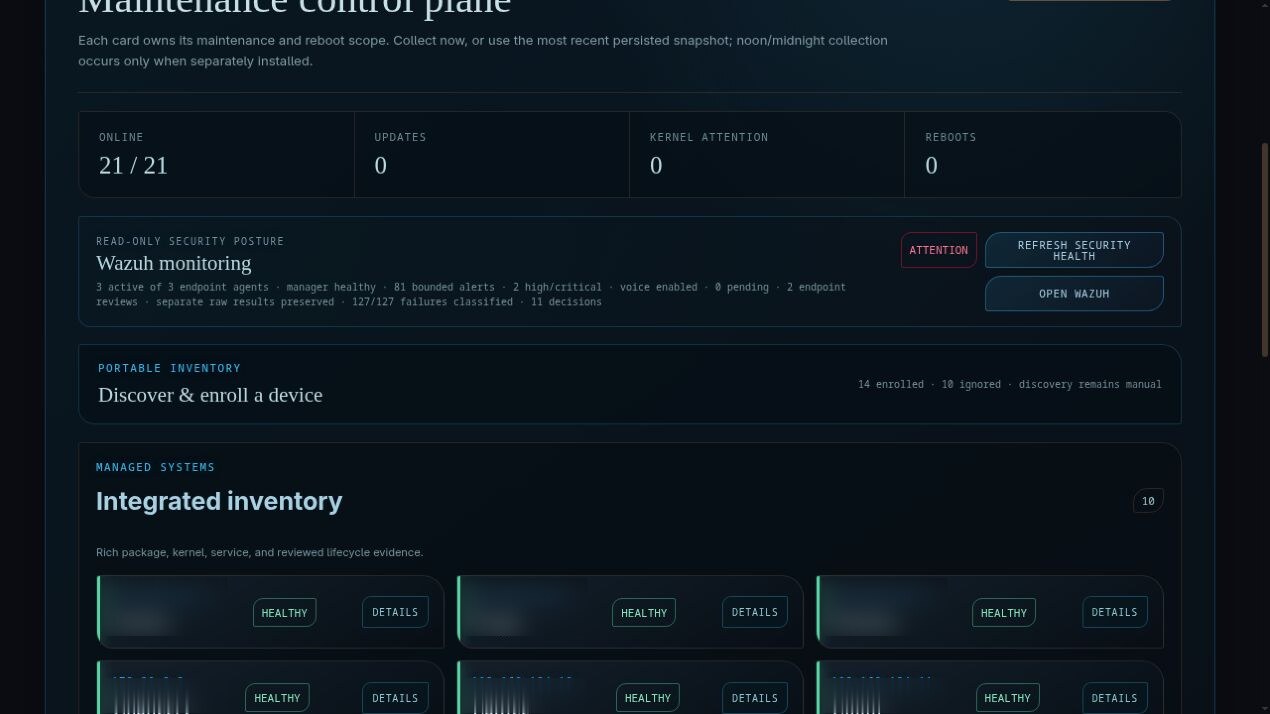
The security card is intentionally an evidence surface, not a remediation console. It reports the bounded posture and leaves investigation to Wazuh and decisions to the Operator.
That is not a lack of ambition. It is an acknowledgement that a security alert is evidence requiring investigation, not proof that malware exists or an intrusion is underway. A clean ClamAV result is equally limited: it is not proof that a file is safe.
Soul/ can help make those uncertainties legible. It cannot responsibly collapse them into a story of its own choosing and act on that story.
The architecture preserves this distinction even where an automated collection schedule exists. Status collection and the supervised backup continuity transaction can be scheduled after separate review. They collect and verify bounded evidence. They do not create a standing right to patch devices, prune history, change permissions, or respond to an alert.
Automation of observation is not autonomy of intervention.
Recovery Is Not Live Replacement
Backup & Recovery is where it would be easiest to make a catastrophic convenience feature.
If a system can capture encrypted snapshots and inspect their history, it is only a short conceptual step to a large red button that restores something directly into the running application. That step is precisely the one Soul/ does not take.
Backup & Recovery captures verified, encrypted snapshots from an owner allow-list, records deletion recovery holds, can maintain a separate off-device copy, and keeps a ledger of the evidence needed to understand retention. Repository passwords are held only for the current page session and are not retained in the dashboard, receipts, or logs.
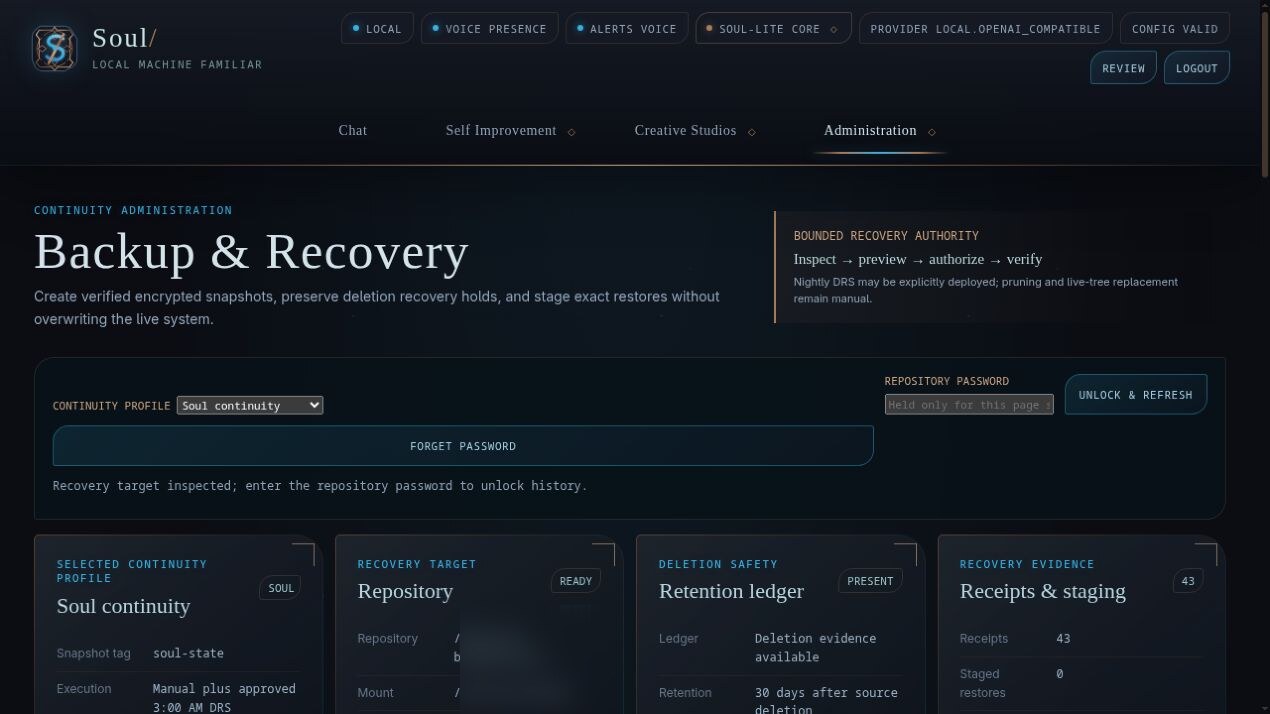
The recovery view makes its limit explicit: inspect, preview, authorize, verify. A restored snapshot goes to isolated private staging, while replacement of live state remains an external human procedure.
When a restore is needed, the workflow chooses one exact snapshot and can optionally narrow the scope to named paths. Soul/ restores that material into an owner-private staging location, verifies what it recovered, and stops for review.
It does not replace live state. It does not revoke sessions. It does not reopen services. It does not decide whether the restored files are the right files to promote.
Those are recovery decisions with consequences beyond file integrity. They belong to the person responsible for the running system.
The same conservatism governs retention. Only explicitly selected, non-newest, hold-clear snapshots can be forgotten, and the operation receives its own preview, bounded prune, and metadata verification. The presence of a retention policy is not permission to clean up on a timer until all the inconvenient history has disappeared.
The Off-Device Copy Is A Second Witness
Crucible, the optional Fedora guest, gives this administration story a useful second location.
It acts as an independently mounted, encrypted restic target for a manually authorized second copy and as a live Fedora/DNF5 qualification target for Guided Maintenance. It does not run Soul/, perform automatic updates, schedule backups on its own, or replace the workstation-local recovery repository.
The second-copy path has its own preview and verification. It copies only missing snapshots and never deletes remote snapshots. If the local capture succeeds but the off-device copy cannot complete, the result says so rather than presenting a partial outcome as a healthy backup story.
Crucible’s maintenance authority is similarly narrow. It can expose only fixed self-check, DNF5 upgrade, and reboot operations through a reviewed helper. It does not grant a generic root shell, a passwordless package manager, an interpreter, or a license to improvise its own recovery sequence.
The goal is not to make a tiny server obedient.
It is to make a small amount of authority inspectable enough to trust.
Administration Is A Continuity Problem
The most useful administrative work is often invisible when it succeeds.
Nothing crashes. A device returns after a reboot. A backup can be located. An alert is understood in context. A known task does not require reconstructing six months of decisions from scattered notes, a terminal history, and the faint memory of what “that one script” was supposed to do.
Soul/’s Administration area is intended to preserve that continuity: an owner-maintained project ledger, current bounded infrastructure evidence, receipts for what actually happened, and a clear separation between inspection, preparation, execution, and review.
It is not an autonomous operations platform.
That is a feature.
The more a system can affect, the more carefully it should distinguish knowing something from being allowed to change it. Soul/ can do meaningful administrative work precisely because it stops before helpfulness becomes presumption.